Software
Systems that keep the assignment and its record together: the documents, instructions, decisions, revisions, and final work product.

Work / What we build
We build software, agents, RL environments, and post-train models for legal work.
The model is one part of the work. We keep the assignment, the system around it, and the evidence that tells us what to change next.
The layer
Systems that keep the assignment and its record together: the documents, instructions, decisions, revisions, and final work product.
Agents that work across tools, keep state, and finish the assignment in a form a person can review and use.
Legal work rebuilt as repeatable tasks. We can see what the agent did, test whether it worked, and use the result in evaluation or training.
Open and specialized models for bounded legal work. We train when the failure survives changes to context, tools, workflow, and evaluation.
Public record
Open model / Released / 25 Aug 2026
Legal retrieval / English + German + Chinese
A 7.57B multilingual dense encoder post-trained on 48,141 public and synthetic legal retrieval examples. The release covers legal retrieval in English, German, and Chinese; it does not establish performance outside those tasks and languages.
002Training report / Published / 12 Jul 2026
Supervised post-training / held-out tasks / limits
A Qwen3.5-9B contract-review run moved from 0.352 to 0.691 across 12 tasks in same-lane evaluation. The report keeps the caveats: one base model, n=10 per cell, and no claim of frontier parity.
003Legal environments / Open / 03 Jul 2026
Corporate actions / records / approvals
Synthetic corporate-law and governance tasks built around records and approvals. The agent has to read what happened, take valid actions, and carry the process through. Synthetic task performance is not evidence of production legal performance.
Interactive work

01 / Legal visualization
Explore the Delaware General Corporation Law as a city. Each building represents a section of the statute.
Enter the city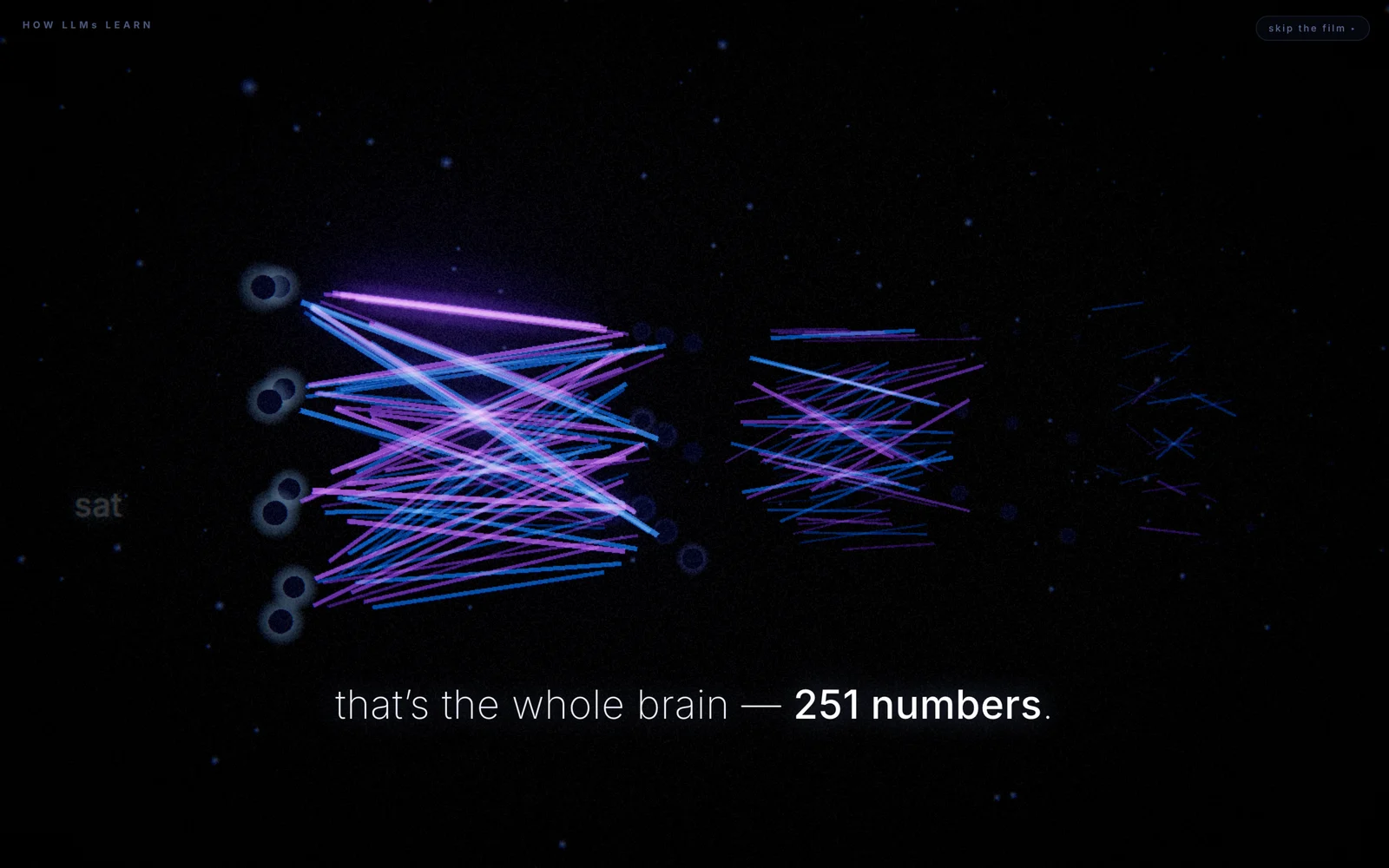
02 / Interactive explainer
Watch a real 251-parameter next-word model make a guess, learn from the error, and change. Then train it yourself.
See the project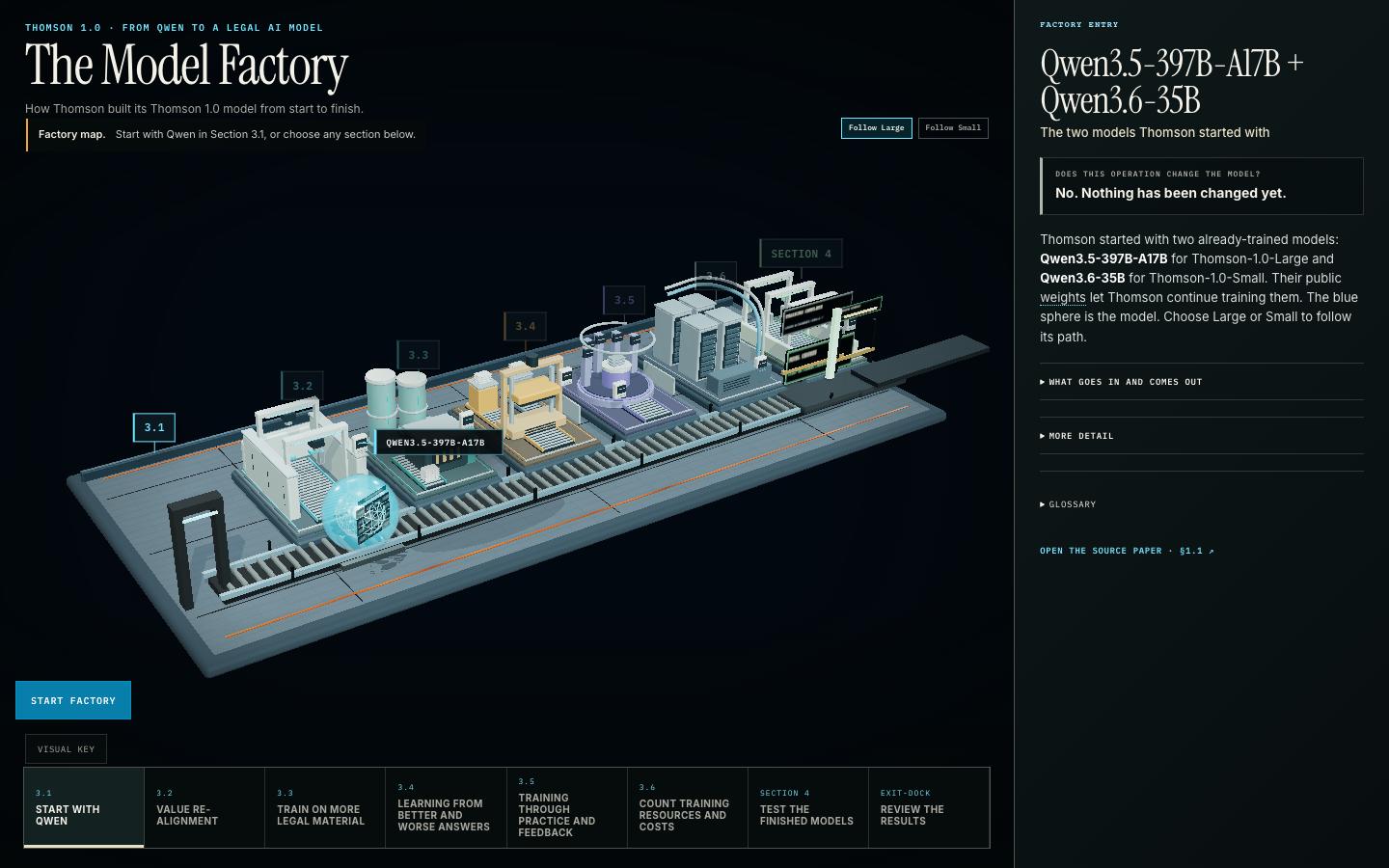
03 / Model training explainer
Follow Thomson 1.0 from its Qwen starting points through post-training and evaluation, one disclosed step at a time.
Enter the factoryWhere the model fits
A bad legal output does not explain itself. We inspect the context, the agent, the evaluation, and the model before deciding what to change.
Did the system have the complete assignment, or did it make a clause-level decision with half the record missing?
Did it keep the instruction in view, use the right tools, and carry state through the work?
Did the evaluation check the work and the final artifact, or reward something that only looked right?
Does the failure remain after the context, tools, agent logic, and evaluation are fixed? Then we train the model.